SLAM and VIO in Egocentric Data: Where Long-Horizon Tracking Breaks
Every layer of an egocentric data pipeline, hand tracking, 3D reconstruction, trajectory extraction, and sim transfer, depends on one thing: knowing precisely where the camera was in 3D space at every frame. This is the state-tracking problem, and in the context of a long-term egocentric setup, it is far harder than most people realize.
One of the promising paths that has converged lately for training generalist robot policies is to collect egocentric video of humans performing manipulation tasks, track the human hand in 3D, and train under a unified representation that maps human demonstrations directly to robot actions.
What A Unified Representation Looks Like
What does a unified representation actually look like?
A robot's hand, though intended to mimic a human hand, is not exactly the same. Classically, the area of robotics that deals with this is kinematics and inverse kinematics. Kinematics finds the position of the end effector given joint angles. Inverse kinematics finds joint angles given the end effector position. In this mapping, the human wrist serves as the analogue to the robot's end effector.
Naturally, the end-effector pose in a human video, estimated by detecting the wrist pose, can be transferred to the robot using inverse kinematics. This places the end effector so that the gripper reaches the same position with the same orientation as seen in the human demonstration. But hand pose models detect the wrist relative to the camera, not the world.
To recover world-frame coordinates, you need to estimate the pose of each camera frame and transform the hand pose in each camera frame into the global frame of reference. This means every centimeter of drift in camera tracking flows directly into the wrist trajectory that the robot will try to replicate.
The pose is typically represented as an `SE(3)` transform: the position and orientation of the end effector in world space. Inverse kinematics then solves for the joint angles that achieve that pose, and since every robot arm has a different kinematic chain, this solution is inherently robot-specific. That handles where the robot's arm goes. But how does a robot manipulate an object?
We humans manipulate objects using the wrist and fingers. One of the popular choices for representing a human wrist and fingers is the MANO representation, which uses 16 joint angles, one for the wrist and 15 for the fingers. Transferring this to a robot depends on the hand it has. For a humanoid hand, the mapping is roughly one-to-one. For a simple parallel-jaw gripper, the entire finger state collapses to a single scalar: thumb-to-index distance as a proxy for gripper aperture.
The entire process of mapping human hand motion to robot-executable actions is called retargeting. And it requires two things at every frame: the camera's 6DoF pose and the detected hand joints.
Why Long-Horizon Tracking Breaks
We've observed three key properties of egocentric manipulation that make long-horizon state tracking fundamentally harder than some of the traditional settings for state tracking:
1. High precision demands in tracking accuracy without drift over long-term operation.
2. High prevalence of degenerate cases of motion estimation.
3. Rapid movement of the human head.
1. Precision Demands Of Long-Term State Tracking
If the robot end-effector position is off by more than 1 to 2 centimeters from where it should be, the grasp fails, the pour misses, and the insertion jams. There are two sources of error here:
a. error in the pose of the camera frame, and
b. error in the wrist pose and its associated joints detected in the ego frame.
State tracking is therefore a central component in reconstructing the hand in world space, so the tracking system itself needs to operate well below that tolerance. The bar here is sub-centimeter precision without drift, sustained over episodes that can run anywhere from five minutes to an hour.
2. Degenerate Cases
Most visual SLAM benchmarks, TUM, EuRoC, KITTI, are captured in mid-range environments. The camera typically maintains 1 to 3 meters of distance from the nearest surface. Under these conditions, modern VIO systems report translational errors in the range of 0.5 to 1% of the total trajectory length.
Now consider what egocentric manipulation actually looks like. Some fraction of the interaction happens at that comfortable 1 to 3 meter range. But a large portion of interactions involve reaching into a kitchen cabinet or leaning over a cutting board, which puts the camera 15 to 20 centimeters from the nearest surface.
The following problems occur during such close-range operation:
Visual feature tracking degrades. At 15 centimeters, surfaces often lack the texture diversity that feature tracking relies on.
Depth sensors saturate or return invalid readings.
The visual field is sometimes dominated by a single plane, and general pose estimation techniques fail to resolve a unique solution for these degenerate configurations. This can be mitigated by switching to pose estimation techniques that explicitly handle planar scenes, but those scenarios need to be detected and handled cleanly.
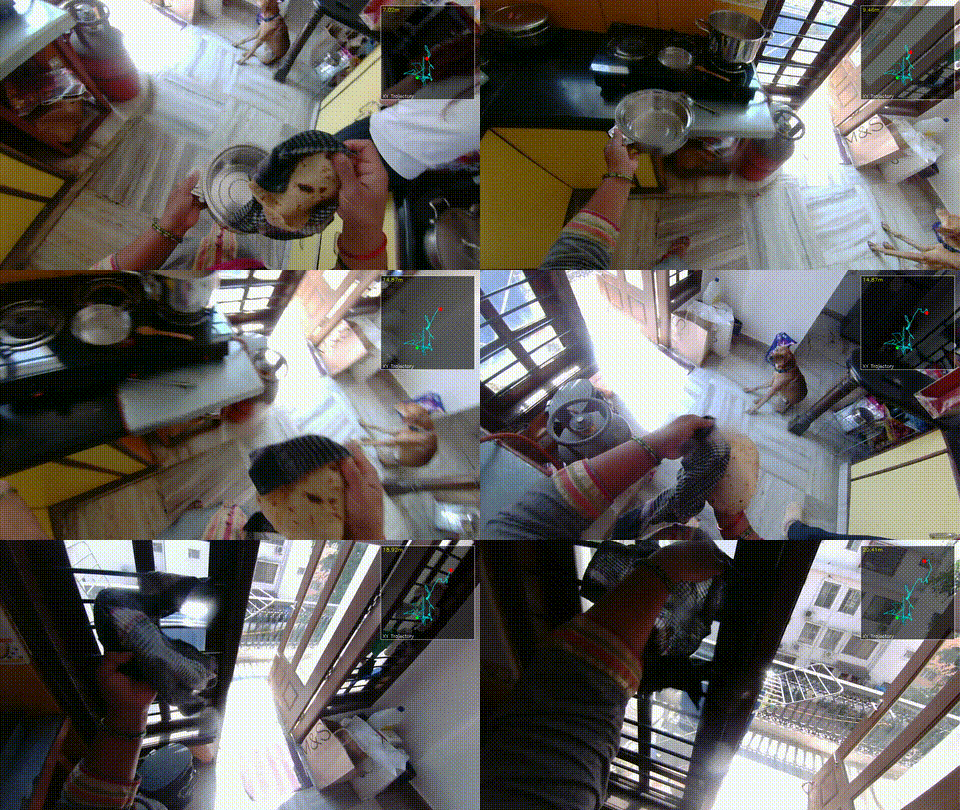
3. Fast Head Motion: The Blur Problem
Egocentric capture has another property that typical SLAM benchmarks do not adequately represent: sudden, aggressive head motion. A person looks down at their hands, then snaps their head up to check something, then looks back down. In a kitchen, this happens every few seconds. Angular velocity of the head can reach up to 120 degrees per second.
At that speed, a typical camera produces frames that are too blurred for feature extraction because of motion blur. When this happens, the system has no choice but to fall back on IMU-only tracking.
Importance Of IMU
It's worth highlighting the role of the IMU here. The IMU provides a way to track state in a problem like this, where other sensing modalities are at risk of intermittent failure. One of the critical metrics to know here is how long the system is forced to operate in IMU-only tracking mode, meaning periods when the only tracking information available comes from the IMU.
In our case, this can sometimes be as high as three minutes. Imagine a user going deep inside a cabinet and searching for some kitchenware. The noise bias stability of the gyroscope and the accelerometer is of critical importance here. The accelerometer bias is often more important than gyroscope bias because of the double integration effect.
Higher-grade IMUs solve much of the bias problem, but at a cost that does not scale to thousands of collection devices. Lower-grade IMUs scale in cost but not in precision. The cost-precision tradeoff in inertial sensor selection makes finding a comfortable middle ground a challenging engineering problem.
The Compounding Problem
None of these failure modes occur in isolation. A person reaches into a cabinet: that's close-range degeneration plus a feature-poor environment. They pull back quickly: that's fast head motion plus IMU bias propagation. The failure modes do not just add up. They multiply.
The close-range frame that loses visual tracking is also the frame where the IMU bias estimate is oldest. The fast head motion that causes blur is also the moment when the user transitions between surfaces or workspace zones, for example counter to cabinet to sink, making the subsequent drift much harder to correct.
This is what makes egocentric state tracking fundamentally different from the SLAM problems that have been studied for decades. The operating conditions are adversarial in a correlated way: the hardest moments for every subsystem coincide.
The Questions The Field Needs To Answer
So here is where we are. VLA training needs sub-centimeter pose precision over long-horizon egocentric episodes. Feature tracking in these environments breaks routinely. The motion is aggressive. The close-range interactions that matter most are the ones where tracking is least reliable. The IMU hardware that can handle this precision does not scale to the device cost the problem demands.
What's the right sensor suite? What's the right fusion strategy? How do you maintain sub-centimeter precision over 30-minute episodes in a kitchen? And how do you do it on hardware cheap enough to put in the hands of thousands of data collectors worldwide?
These are some of the questions we've been obsessing over for the last eight months, and the answers are what we've built our entire infrastructure around.
More on that in the next post.
For more details, reach us at [email protected]
Follow us on X at @fpv_labs